
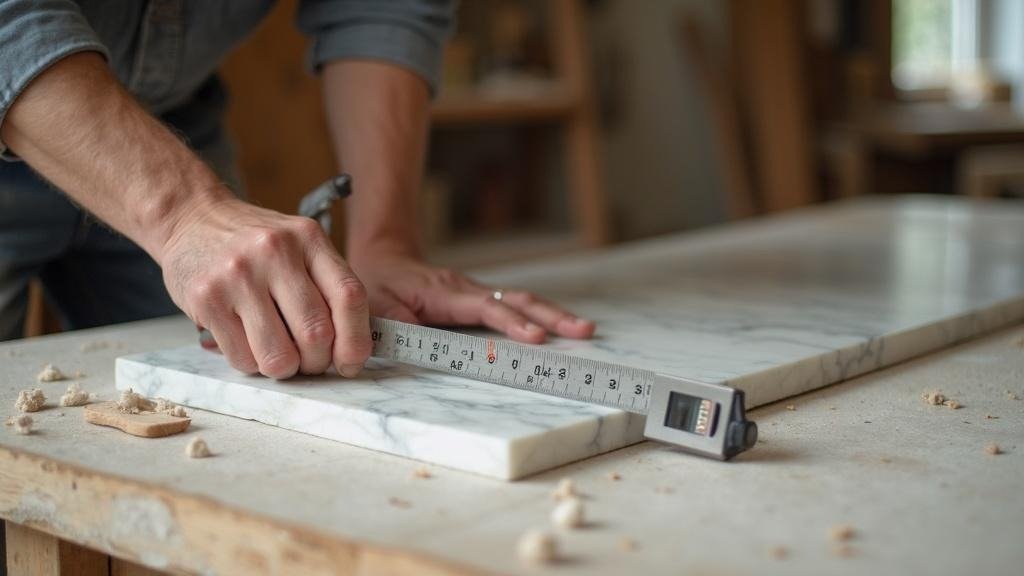
Something shifted in this space over the last couple of years. For a long time, stone fabricators either ran Moraware or they ran nothing (spreadsheets, a whiteboard, and prayer). Now a second wave of tools has arrived that assumes you already have CNC equipment, digital templating, and a backlog of DXF files. That changes what “good software” even means. The conversation moved from basic job tracking to AI nesting, DXF validation, and quote-to-payment in a single workflow. I looked at six real options to figure out where the money actually goes.
What I Looked At
Before the list, here is the short version of my criteria. I wanted to know: does it speak stone specifically (not generic shop management)? Does quoting connect to payment, or do you still chase checks? Can it handle DXF files without a manual cleanup step? Does it reduce slab waste in a measurable way, or just promise to? And what does it cost a two-to-five person shop versus a ten-plus-person operation?
The 6 Best Countertop Shop Software Options
1. Moraware CounterGo + Systemize
The incumbent. Over 2,600 fabricators use Moraware products, which tells you something about the install base and the integrations other vendors have built around it. CounterGo is the drawing and quoting layer, priced around $100 per user per month, and it is genuinely fast for producing a visual quote from a field sketch. Systemize sits on top for scheduling and job tracking, running roughly $200 to $400 per month depending on modules, with additional users after five running about $50 each. ActionFlow adds workflow automation. The trade-off is that these modules feel like what they are: built over time, piece by piece, by a company that grew up before cloud-native design tools existed. It is not a criticism of the company. It is just a structural reality that newer entrants do not carry.
See also: Brooke Devard Net Worth: How Much Has the Influencer Earned?
2. SlabWise
If your bottleneck is slab yield and CNC prep, this is the one worth trying first. SlabWise is a cloud tool built specifically for custom stone fabricators who run CNC equipment and handle a steady volume of templated jobs. The part that earns its place on this list is the AI nesting engine. It batches multiple jobs onto a single slab at once, accounts for vein direction, handles edge rotation, and supports book-matching, which means less guessing and less scrap compared to dragging shapes around manually. I have seen shops treat nesting as a “we’ll figure it out at the saw” problem. SlabWise makes that a pre-production problem instead, which is the right order. The DXF middleware is genuinely useful too. It validates geometry, catches sink cutout errors, and prepares files for the CNC before anything hits the machine. The quoting tool pulls measurements directly from those DXFs and builds a Good/Better/Best material tier presentation that ends with e-signature and Stripe payment collection in the same window. The company reports meaningful reductions in slab waste and higher quote close rates with the tiered pricing approach. Those are their own figures, but the logic behind tiered quoting is sound regardless. Pricing starts around $99 per month for a limited job count, with a Pro tier near $299 for unlimited jobs and an Enterprise option for multi-location shops. The $1 for seven days trial is a low enough bar that there’s no good reason not to test it on a real job.
3. FabSuite
FabSuite is a shop management platform aimed at stone fabricators who want inventory, scheduling, and job tracking in one place. It is more operationally focused than quote-forward. If your pain point is knowing where a slab is in the building and who is working on which job, FabSuite addresses that directly. It handles purchase orders and connects material inventory to job status. Less flashy than newer entrants. Solid for mid-size shops where the foreman needs real-time job visibility.
4. SigmaNEST
SigmaNEST is an advanced CNC nesting platform that is not exclusive to stone. It is used across metal fabrication, glass, and other cut-to-shape industries. For a high-volume stone operation running complex shapes, the yield optimization is serious. The learning curve is real, and the cost structure reflects enterprise-grade software. Most countertop shops do not need this level of horsepower, but if you are running dozens of slabs a day and every percentage point of yield matters financially, it belongs on your shortlist.
5. EasySTONE / EasyStoneShop
EasySTONE combines CAD/CAM with shop management in one package. Entry pricing is around $150 per month, which makes it approachable for smaller shops. The CAD side handles edge profiles, sink cutouts, and machining paths, so there is less hand-off friction between design and production. It has a European user base historically, though it is available in the US market. Some shops use it purely for the CAM output and handle quoting elsewhere.
6. Spreadsheets, QuickBooks, and Manual Workflows
This deserves a spot because most shops still run here, at least partially. QuickBooks handles billing. A shared spreadsheet tracks jobs. Someone texts the templater. The cost looks low until you count the hours spent reconciling, the quotes that never closed because they arrived as a PDF three days later, and the slab you cut wrong because the sink dimension in the DXF was never verified. The tools above all exist to solve problems this combination creates.
How to Choose
Start with your actual bottleneck. If it is quoting speed and close rate, CounterGo is the proven answer with the most integrations already built around it. If it is slab yield and CNC prep time, SlabWise is purpose-built for exactly that problem and cheap enough to test before committing. If it is shop-floor visibility and inventory control, FabSuite is worth a demo. High-volume CNC operations with complex nesting needs should look at SigmaNEST separately from whatever job management tool they run. No single platform is perfect for every shop size or workflow. The good news is that most of these offer trials, and a real job will tell you more than any feature comparison chart.
Common Questions
Can SlabWise replace Moraware, or do shops typically run both?
They target different problems, so some shops do run both. Moraware CounterGo and Systemize are strongest on quoting from field sketches and job scheduling. SlabWise is strongest on DXF-driven nesting, CNC file prep, and payment collection. A shop that already has Moraware deeply embedded in its workflow might add SlabWise specifically for the nesting and CNC side rather than switching outright.
Does countertop shop software actually handle DXF files from Leica or Proliner digital templaters, or does someone still clean them up manually?
It depends on the tool. SlabWise includes DXF middleware that validates geometry and catches errors like bad sink cutout dimensions before the file reaches the CNC. EasySTONE handles DXF import on the CAM side as well. Moraware CounterGo is more sketch-and-draw based and is not primarily a DXF-processing tool, so templater file handling there typically involves a separate step.
For a two-person granite shop running maybe 15 jobs a month, is any of this worth the monthly cost?
At 15 jobs a month, the math tightens. Moraware CounterGo at $100 per user gets expensive fast for a tiny team. SlabWise at $99 for a limited job count is closer to the right scale, and the $1 trial makes it easy to check. The honest answer is that quoting speed and close rate improvements tend to pay for software faster than nesting savings do at low volume.
Does FabSuite connect to QuickBooks, or does it replace it entirely?
FabSuite is a shop management and job tracking platform, not a general accounting replacement. Most shops using FabSuite still run QuickBooks alongside it for accounting and payroll. The two systems handle different parts of the operation, and FabSuite’s value is in the production-side visibility, purchase orders, and inventory tracking rather than in eliminating QuickBooks.
Is SigmaNEST overkill for a countertop fabricator, or are there shop sizes where it genuinely makes sense?
For most countertop shops, yes, it is overkill. SigmaNEST is enterprise-grade software built for high-volume, multi-material cut-to-shape operations. It makes sense if you are cutting dozens of slabs daily, running complex custom shapes, and have staff with CAM experience to manage it. A shop doing 30 to 50 residential countertop jobs a month will get better value from a purpose-built stone tool like SlabWise.
*Pricing figures are approximate and subject to change. Verify current rates directly with each vendor before purchasing.*
Sources
- Moraware website (public pricing and product pages, accessed 2025)
- FabSuite website (product overview, public)
- SigmaNEST website (product overview, public)
- EasySTONE / EasyStoneShop website (public product and pricing information)
- SlabWise public pricing and feature pages
- Stone World and StonExus industry publications (general market context)

